Specialties / OB/GYN
OB/GYN billing, done for you
Your providers document the care. We code the maternity package, prenatal visits, screenings and problem visits, check every claim, and follow it until it is paid. You keep your EMR and see every claim live.
Live for OB/GYN practices.
The rules we code and check before an OB/GYN claim goes out
| Rule | What it means | What we check | Who decides |
|---|---|---|---|
| Global obstetric package | 59400 (vaginal delivery), 59510 (cesarean), 59610 and 59618 (after a previous cesarean) cover routine antepartum care, the delivery and postpartum care in one code. Fetal monitoring in labor, episiotomy, delivery of the placenta and antepartum urinalysis are inside it. | One package code per pregnancy, with no included visit or service billed on its own | Mohenara codes the package from your delivery and prenatal records |
| What the package leaves out | Ultrasound, amniocentesis, genetic screening, visits for conditions unrelated to the pregnancy and extra visits for high-risk conditions are billed on their own. | The reason for each extra visit in the note, so it is billed and not lost inside the package | Mohenara, from your provider's notes |
| Antepartum care only | When your practice does not deliver the baby: 1 to 3 prenatal visits are billed as office visits, 4 to 6 as 59425, and 7 or more as 59426. Postpartum care alone is 59430. | The visit count for the pregnancy before the code is chosen | Mohenara, from your visit history |
| Maternity codes change in 2027 | From January 1, 2027, CPT replaces the global maternity codes with separate codes. Medicare has proposed either paying the new codes or keeping today's package through G codes. Care that spans the change follows the AMA's transition rules. | The code set each payer accepts for the date of service | Mohenara applies each payer's final rule |
| Medicare screening pelvic exam and Pap | Screening pelvic and breast exam (G0101): every 2 years, or every year for a patient at high risk or of childbearing age with an abnormal exam in the past 3 years. Pap collection (Q0091): every 2 years, or every year at high risk. No deductible; coinsurance applies. | The date of the last covered screen and the risk diagnosis on the claim; an ABN when a screen is not due | Mohenara codes the risk from the note; your front desk gets the ABN signed |
| A problem treated at a preventive visit | A separate problem visit on the same day as G0101 or Q0091 is billed with 25 and its own documentation. Medicare does not cover a routine preventive visit (99381 to 99397); a covered visit the same day is paid in place of part of it. | 25 only when the note documents the problem apart from the screening | Mohenara, from the note. We never add 25 to a visit the note does not support |
| Well-woman visits | Marketplace plans and many other plans cover a yearly well-woman visit with no copay or coinsurance, even before the deductible is met. | Preventive and problem services on separate lines, so the patient is not charged for the preventive part | Mohenara codes both from the note |
Medicare updates code-pair edits each quarter and fees each January.
Before the visit
Software
Automated check
- Coverage active, plan dates, copay, coinsurance and deductible, as the insurance company returns them.
- An answer the payer leaves incomplete stays unknown, never zero.
Software
Tracking
- Prenatal visits for each pregnancy, so the right package or antepartum code is billed.
- Authorizations, with approved codes and dates.
You
Your front desk
- Fixes insurance cards and details in your EMR.
- Requests authorizations.
- Gets Advance Beneficiary Notices (ABNs) signed when a screening is not due.
- Collects copays.
A coverage check is not a guarantee of payment.
What you see
Every claim, live. Billed, paid, owed and for how long, by payer.
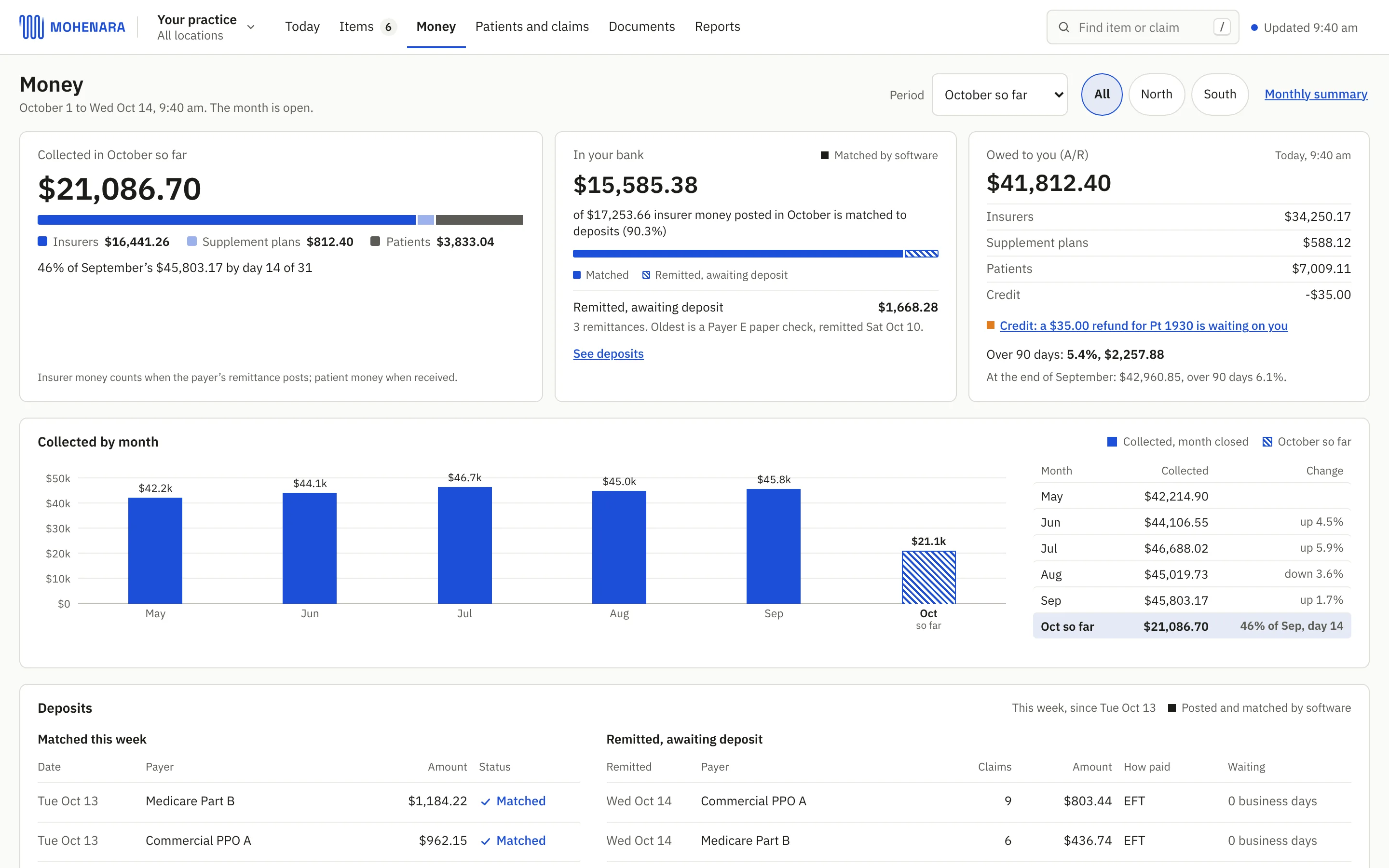
Your dashboard, Money.See the live dashboard
Get a billing plan for your practice
Your price at 3.5% of what we collect, worked on your numbers.