Specialties / Orthopedics
Orthopedic billing, done for you
Your surgeons document the care. We code every visit and procedure, check it against Medicare's and your payers' rules, and follow it until it is paid. You keep your EMR and see every claim live.
Live for orthopedic practices.
The rules we code and check before an orthopedic claim goes out
We check code pairs and daily unit limits against Medicare's current quarterly files.
| Rule | What it means | What we check | Who decides |
|---|---|---|---|
| Global surgery periods | Every surgery code carries 0, 10 or 90 global days. Follow-up visits related to the surgery inside that window are part of the surgery fee. A 90-day window also covers the day before surgery. | Every visit date against the patient's open global windows for the same surgeon or group | Mohenara, from the global days in Medicare's fee schedule file |
| Modifiers 24, 57, 58, 78 and 79 | Inside a global window: 24 for an unrelated visit, 58 for a staged procedure decided in advance, 78 for a related return to the operating room, 79 for an unrelated procedure. 57 marks the visit that decided on a major surgery, the day before or the day of it. | The note supports the modifier: an unrelated diagnosis for 24 and 79, the plan for 58, an operating room return for 78 | Mohenara codes the modifier from your surgeon's note |
| Modifier 25 with a joint injection | A joint injection (20610, 20611) is a minor procedure with a 0-day global. The visit that decides on the injection is part of it. A visit is billed the same day, with 25, only when the note shows significant, separate work. | Separate history, exam or decision making in the note before 25 goes on the visit | Mohenara, from the note. We never add 25 to a visit the note does not support |
| Injection codes and units | 20610 is a large-joint injection or aspiration without ultrasound guidance; 20611 is the same with it. One unit per joint, its bursae included. | Ultrasound guidance documented before 20611; one unit per joint | Mohenara codes from your provider's procedure note |
| Right, left and both sides | Medicare wants a procedure done on both sides on one line, with 50 and 1 unit, paid at up to 150%. That differs from CPT's two-line method, so each payer's rule decides. A code already described as bilateral takes no 50. | The side in the note matches RT, LT or 50, in the form each payer accepts | Mohenara codes the side from the note |
| Code pairs, 59 and XE, XS, XP, XU | Medicare's code-pair edits deny the second code of a pair done at the same site and visit. 59, or the more specific XE, XS, XP or XU, applies only when the note shows a separate visit, site or practitioner. | Every code pair against the current quarterly edit file; a modifier only with documentation behind it | Mohenara, from the note and the edit file |
| Casts and splints | Splint and casting supplies are paid on their own, apart from the application. Removing a cast or splint inside a global window is part of the surgery. | Supply lines on the claim when a cast or splint is applied in the office; no removal billed inside a global window | Mohenara codes from the note |
| Authorizations for imaging and surgery | Many plans require authorization first. Most UnitedHealthcare commercial plans, for example, require it for CT, MRI and PET in the office; without it the claim can be denied and the patient cannot be billed. Medicare Advantage plans must answer standard requests within 7 calendar days. | Authorization number on the claim; service inside the approved codes and dates | Your front desk requests authorizations; Mohenara tracks them |
Medicare updates code-pair edits each quarter and global days and fees each January.
Braces and equipment you dispense
Written orders, rental or purchase modifiers, KX and proof of delivery follow the equipment rules. We bill them too.
Before the visit
Software
Automated check
- Coverage active, plan dates, copay, coinsurance and deductible, as the insurance company returns them.
- An answer the payer leaves incomplete stays unknown, never zero.
Software
Tracking
- Authorizations for imaging and surgery, with approved codes and dates.
- Each patient's open global windows, so a post-op visit is not billed by mistake.
You
Your front desk
- Fixes insurance cards and details in your EMR.
- Requests authorizations.
- Gets Advance Beneficiary Notices (ABNs) signed when needed.
- Collects copays.
A coverage check is not a guarantee of payment.
What you see
Every claim, live. Billed, paid, owed and for how long, by payer.
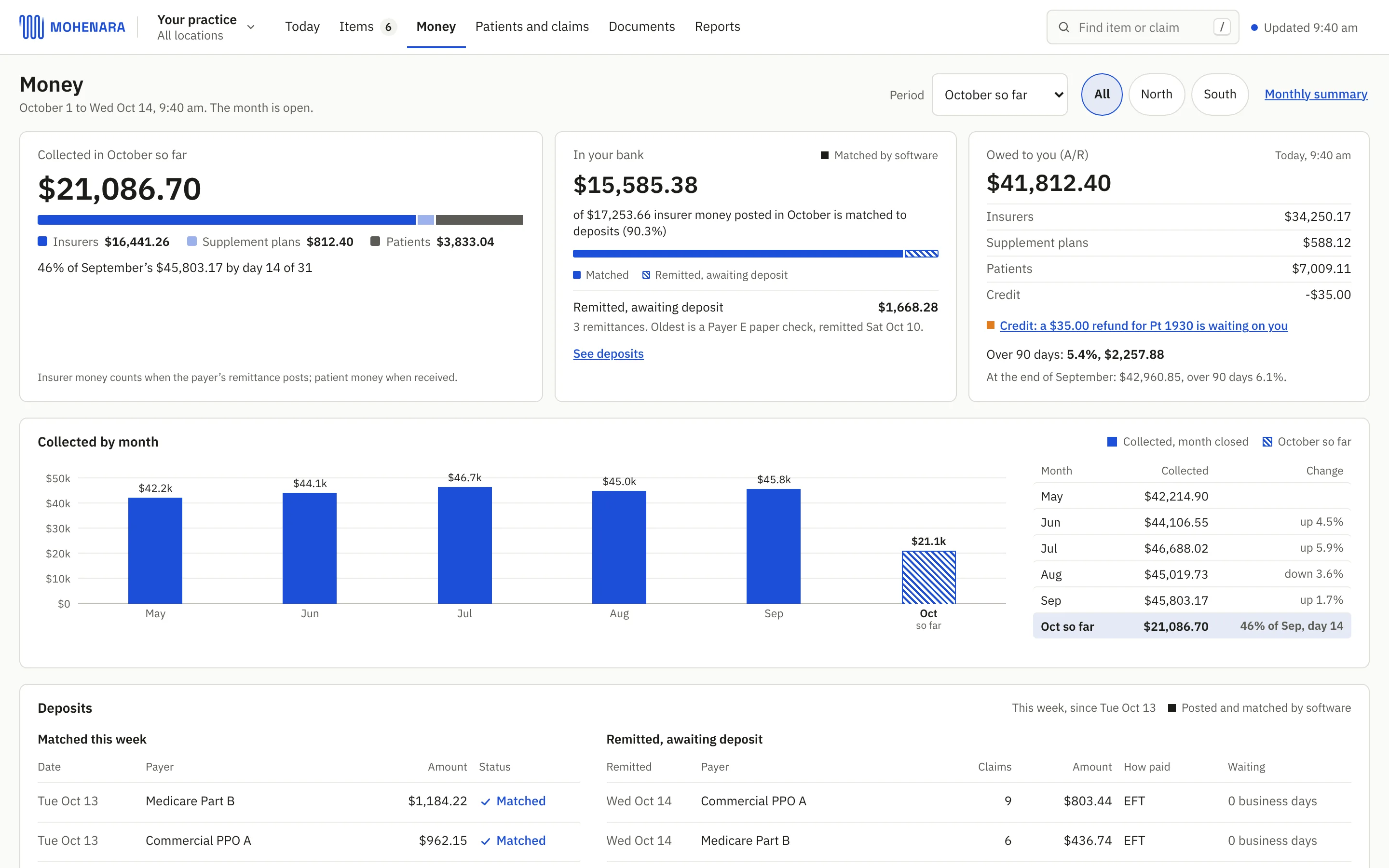
Your dashboard, Money.See the live dashboard
Get a billing plan for your practice
Your price at 3.5% of what we collect, worked on your numbers.